
|
Training, Open Source Programming Languages |
| Home | Accessibility | Courses | The Mouth | Resources | Site Map | About Us | Contact |
| For 2023 (and 2024 ...) - we are now fully retired from IT training. We have made many, many friends over 25 years of teaching about Python, Tcl, Perl, PHP, Lua, Java, C and C++ - and MySQL, Linux and Solaris/SunOS too. Our training notes are now very much out of date, but due to upward compatability most of our examples remain operational and even relevant ad you are welcome to make us if them "as seen" and at your own risk. Lisa and I (Graham) now live in what was our training centre in Melksham - happy to meet with former delegates here - but do check ahead before coming round. We are far from inactive - rather, enjoying the times that we are retired but still healthy enough in mind and body to be active! I am also active in many other area and still look after a lot of web sites - you can find an index ((here)) |
 Well House Consultants
You are on the site of
Well House Consultants
who provide
Open Source Training Courses
and business
hotel accommodation. You are welcome to browse and use
our resources subject to our copyright statement and to add in links from your pages to ours.
Other subject areas - resources
Java ResourcesWell House Manor Resources Perl Resources Python Resources PHP Resources Object Orientation and General topics MySQL Resources Linux / LAMP / Tomcat Resources Well House Consultants Resources Extras Resources C and C++ Resources Ruby Resources Tcl/Tk Resources Web and Intranet Resources | Perl module P402
Writing Your Own Simple Client and Server
Exercises, examples and other material relating to training module P402. This topic is presented on public course Using Perl on the Web
Perl originated from a requirement to write network-aware scripts, and it's always been a great language for writing both clients and servers. You might wonder if you really need to write such programs these days but, yes, there are times that you want to write test programs against which to run a stanard client or server, and times that you want to provide a specialist tool that talks directly to another network process.
Examples from our training material
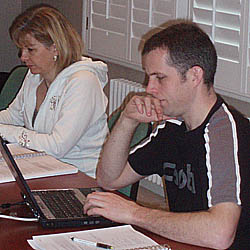
Pictures Learning how to use Perl behind a web site
Background information
Some modules are available for download as a sample of our material or under an Open Training Notes License for free download from [here].
Topics covered in this module
A further use of telnet.
Using RFC868 time protocol. Using the Socket module. Name Services. Running network commands directly. Other enhancements. Writing your own simple server. End-of-line characters. Buffering. Example - finger client. Complete learning
If you are looking for a complete course and not just a information on a single subject, visit our Listing and schedule page. Well House Consultants specialise in training courses in Ruby, Lua, Python, Perl, PHP, and MySQL. We run Private Courses throughout the UK (and beyond for longer courses), and Public Courses at our training centre in Melksham, Wiltshire, England. It's surprisingly cost effective to come on our public courses - even if you live in a different country or continent to us. We have a technical library of over 700 books on the subjects on which we teach. These books are available for reference at our training centre. | ||||||||||||||||||||||||||||||
PH: 01144 1225 708225 • EMAIL: info@wellho.net • WEB: http://www.wellho.net • SKYPE: wellho
PAGE: http://www.wellho.net/resources/P402.html • PAGE BUILT: Sun Oct 11 14:50:09 2020 • BUILD SYSTEM: JelliaJamb