
|
Training, Open Source Programming Languages |
| Home | Accessibility | Courses | The Mouth | Resources | Site Map | About Us | Contact |
| For 2023 (and 2024 ...) - we are now fully retired from IT training. We have made many, many friends over 25 years of teaching about Python, Tcl, Perl, PHP, Lua, Java, C and C++ - and MySQL, Linux and Solaris/SunOS too. Our training notes are now very much out of date, but due to upward compatability most of our examples remain operational and even relevant ad you are welcome to make us if them "as seen" and at your own risk. Lisa and I (Graham) now live in what was our training centre in Melksham - happy to meet with former delegates here - but do check ahead before coming round. We are far from inactive - rather, enjoying the times that we are retired but still healthy enough in mind and body to be active! I am also active in many other area and still look after a lot of web sites - you can find an index ((here)) |
|
Ruby on Rails - how it flows, and where the files go
Ruby on Rails is a web framework that lets you use Ruby code to add dynmaics to your web site, using the MVC (Model, View, Controller) architecture that keeps the look and feel of the page (View) apart from the business logic (Model), linking the two via the Controller. Rails provides the framework for you to work in - you extend default (supplied) classes in your controller and model, and provide HTML files with embedded Ruby calls to supplied functions to add in your dynamic changes to the look and feel. With rails providing a number of elements, you need to know where the hooks are to put your code / web page, and here are two diagrams from yesterday's course showing the elements in logical (operational) order, and where each of them fits in the file system tree. 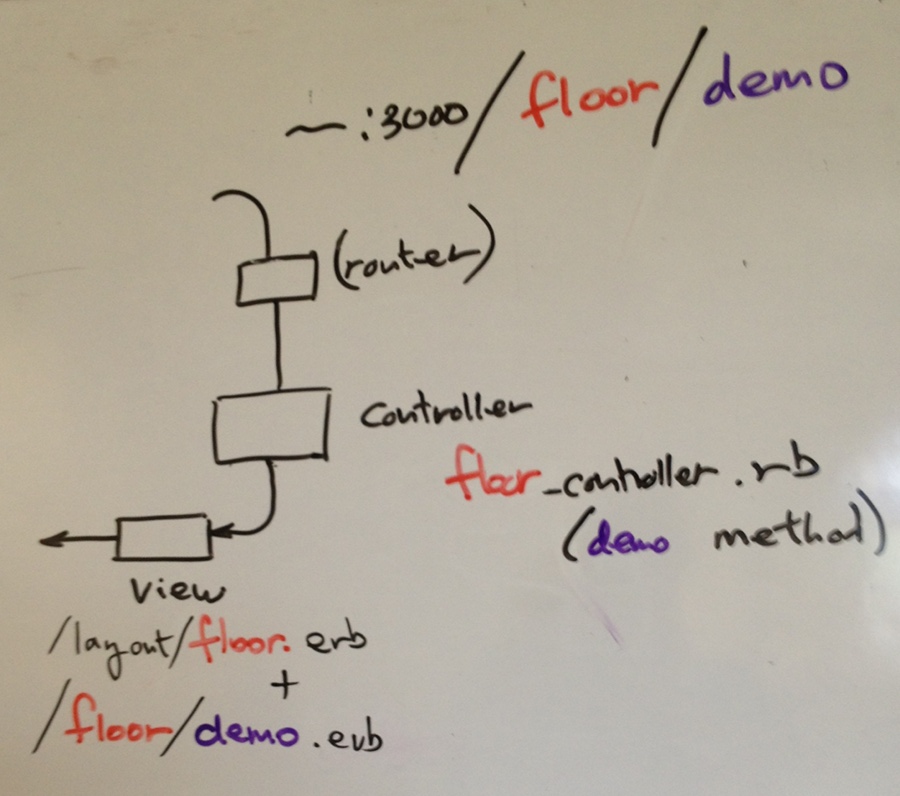 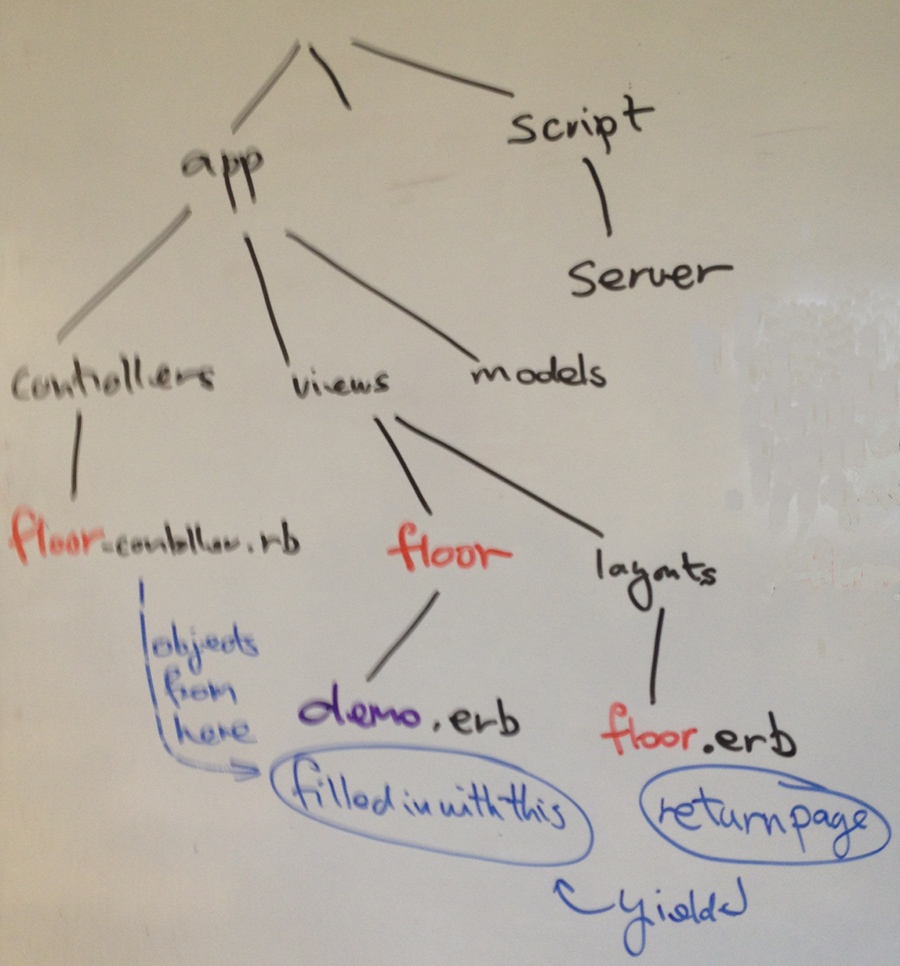 The file names used aren't explicity stated as you write your code - they're implicitly derived from the the URL you use. Further, the method called demo within the floor controller is implicitly the code that was called when the URL was called up ... The URL was http://localhost:3000/floor/demo (using WEBrick test server, running on the development machine, so - sorry - not available for you to click on and run on our live server!) Next public Ruby course - the week after next - you'll find details [here]. If you come back to this page on the archives and have missed the June course, there are others later this year, and the schedule for next year will be published in the same place in the late summer. (written 2012-06-08, updated 2012-06-09) Associated topics are indexed as below, or enter http://melksh.am/nnnn for individual articles R202 - Ruby on Rails[1050] The HTML++ Metalanguage - (2007-01-22) [1302] Ruby, Ruby, Ruby. Rails, Rails, Rails. - (2007-08-13) [1375] Python v Ruby - (2007-10-02) [1745] Moodle, Drupal, Django (and Rails) - (2008-08-08) [2605] Ruby on Rails - a sample application to teach you how - (2010-01-30) [2607] Answers on Ruby on Rails - (2010-01-30) [2609] Scope of variables - important to Ruby on Rails - (2010-01-31) [3624] Why do we need a Model, View, Controller architecture? - (2012-02-25) [3772] Hello World - Ruby on Rails - a checklist of each step - (2012-06-22) [3777] Multiple views in a single appication - sharing common parts of the template - Ruby on Rails - (2012-06-23) [3778] Providing a form to allow the user to add data to the model - Ruby on Rails - (2012-06-23) [3779] Adding validation to form entries and sticky fields - Ruby on Rails - (2012-06-23) [3780] Ruby of Rails - cleanly displaying model data in the view - (2012-06-23) [3919] What is a web framework? - (2012-11-10) [4010] Really Simple Rails - (2013-02-17) [4013] Web Frameworks - nested templates - (2013-02-22)
Some other Articles
Why you should use objects even for short data manipulation programs in RubyThe five oldest blogs and the horses mouth Ruby - standard operators are overloaded. Perl - they are not Ruby - a teaching example showing many of the language features in short but useful program Ruby on Rails - how it flows, and where the files go Cruising on the Mersey Ferry? Eyes Wide Open Adding a passcode to a directory Melksham Visitors Map - Bus routes and train lines to and from the town Public transport for international arrivals into Melksham |
4759 posts, page by page
Link to page ... 1, 2, 3, 4, 5, 6, 7, 8, 9, 10, 11, 12, 13, 14, 15, 16, 17, 18, 19, 20, 21, 22, 23, 24, 25, 26, 27, 28, 29, 30, 31, 32, 33, 34, 35, 36, 37, 38, 39, 40, 41, 42, 43, 44, 45, 46, 47, 48, 49, 50, 51, 52, 53, 54, 55, 56, 57, 58, 59, 60, 61, 62, 63, 64, 65, 66, 67, 68, 69, 70, 71, 72, 73, 74, 75, 76, 77, 78, 79, 80, 81, 82, 83, 84, 85, 86, 87, 88, 89, 90, 91, 92, 93, 94, 95, 96 at 50 posts per pageThis is a page archived from The Horse's Mouth at http://www.wellho.net/horse/ - the diary and writings of Graham Ellis. Every attempt was made to provide current information at the time the page was written, but things do move forward in our business - new software releases, price changes, new techniques. Please check back via our main site for current courses, prices, versions, etc - any mention of a price in "The Horse's Mouth" cannot be taken as an offer to supply at that price.
Link to Ezine home page (for reading).
Link to Blogging home page (to add comments).
PH: 01144 1225 708225 • EMAIL: info@wellho.net • WEB: http://www.wellho.net • SKYPE: wellho
PAGE: http://www.wellho.net/mouth/3756_Rub ... es-go.html • PAGE BUILT: Sun Oct 11 16:07:41 2020 • BUILD SYSTEM: JelliaJamb