
|
Training, Open Source Programming Languages |
| Home | Accessibility | Courses | The Mouth | Resources | Site Map | About Us | Contact |
| For 2023 (and 2024 ...) - we are now fully retired from IT training. We have made many, many friends over 25 years of teaching about Python, Tcl, Perl, PHP, Lua, Java, C and C++ - and MySQL, Linux and Solaris/SunOS too. Our training notes are now very much out of date, but due to upward compatability most of our examples remain operational and even relevant ad you are welcome to make us if them "as seen" and at your own risk. Lisa and I (Graham) now live in what was our training centre in Melksham - happy to meet with former delegates here - but do check ahead before coming round. We are far from inactive - rather, enjoying the times that we are retired but still healthy enough in mind and body to be active! I am also active in many other area and still look after a lot of web sites - you can find an index ((here)) |
|
Transforming data in Perl using lists of lists and hashes of hashes
In Perl, you don't have conventional two dimensional arrays - you have lists which are single dimensional only. However, you can have a list that contains a reference to another list, in effect a list of lists. Very powerful stuff as it leads to a very flexible way of handling data structures - we cover it briefly on our Perl Programming Course and in much more depth on Perl for Larger Projects. 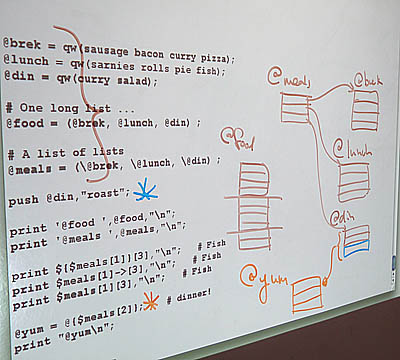 As you write code using lists of lists (and hashes of lists and the other alternatives too), you are very strongly advised to draw a diagram of what you are trying to achieve. It will do wonders for you. That way you can see the difference between a list which is a concatenation of other lists, and a list of lists. Say, for example, I had three options for breakfast, 4 for lunch and 4 for dinner, a concatanated list would be 11 elements long, but a list of lists would contain three elements. There's a source code example here from today's course. The diagram alongside shows how this code works. As you write code using lists of lists (and hashes of lists and the other alternatives too), you are very strongly advised to draw a diagram of what you are trying to achieve. It will do wonders for you. That way you can see the difference between a list which is a concatenation of other lists, and a list of lists. Say, for example, I had three options for breakfast, 4 for lunch and 4 for dinner, a concatanated list would be 11 elements long, but a list of lists would contain three elements. There's a source code example here from today's course. The diagram alongside shows how this code works.One of the big uses of hashes of lists (as an example of a collection of collections) is in inverting data. Let's say I have a file in which each line starts with a person's name, and the person's skills are then listed along the line. But I want to turn that around so that I can see a list of skills, with the people holding each skill alongside the skill. It turns out to be a handful of lines of code - see here. What works for people and skills is equally good in transforming a web access log file, listing by visiting client, into a report on each of the web pages on your website and telling you how many people have visited each of them! Three further examples: reading the people / skills file into a list of hashes and the data inversion with a web (CGI) interface. Finally, the data inversion with a search facility. (written 2009-06-12, updated 2009-06-14) Associated topics are indexed as below, or enter http://melksh.am/nnnn for individual articles P409 - Perl - Searching[1183] Improving searches - from OR to AND? - (2007-05-11) P207 - Perl - File Handling [12] How many people in a room? - (2004-08-12) [114] Relative or absolute milkman - (2004-11-10) [255] STDIN, STDOUT, STDERR and DATA - Perl file handles - (2005-03-23) [616] printf - a flawed but useful function - (2006-02-22) [618] Perl - its up to YOU to check your file opened - (2006-02-23) [702] Iterators - expressions tha change each time you call them - (2006-04-27) [867] Being sure to be positive in Perl - (2006-09-15) [1312] Some one line Perl tips and techniques - (2007-08-21) [1416] Good, steady, simple example - Perl file handling - (2007-10-30) [1442] Reading a file multiple times - file pointers - (2007-11-23) [1467] stdout v stderr (Tcl, Perl, Shell) - (2007-12-10) [1709] There is more that one way - Perl - (2008-07-14) [1841] Formatting with a leading + / Lua and Perl - (2008-10-15) [1860] Seven new intermediate Perl examples - (2008-10-30) [1861] Reactive (dynamic) formatting in Perl - (2008-10-31) [2405] But I am reading from a file - no need to prompt (Perl) - (2009-09-14) [2818] File open and read in Perl - modernisation - (2010-06-19) [2821] Chancellor George Osborne inspires Perl Program - (2010-06-22) [2833] Fresh Perl Teaching Examples - part 2 of 3 - (2010-06-27) [3326] Finding your big files in Perl - design considerations beyond the course environment - (2011-06-14) [3548] Dark mornings, dog update, and Python and Lua courses before Christmas - (2011-12-10) [3830] Traversing a directory in Perl - (2012-08-08) [3839] Spraying data from one incoming to series of outgoing files in Perl - (2012-08-15)
Some other Articles
Taking a pride in the communityAlumni - revisiting and supporting the old University Sending awkward characters by email in Perl Loading external code into Perl from a nonstandard directory Transforming data in Perl using lists of lists and hashes of hashes Why sendmail one way, and pop3 the other? What is CGI.pm / A dozen new examples Running a piece of code is like drinking a pint of beer Do not re-invent the wheel - use a Perl module Where do I start when writing a program? |
4759 posts, page by page
Link to page ... 1, 2, 3, 4, 5, 6, 7, 8, 9, 10, 11, 12, 13, 14, 15, 16, 17, 18, 19, 20, 21, 22, 23, 24, 25, 26, 27, 28, 29, 30, 31, 32, 33, 34, 35, 36, 37, 38, 39, 40, 41, 42, 43, 44, 45, 46, 47, 48, 49, 50, 51, 52, 53, 54, 55, 56, 57, 58, 59, 60, 61, 62, 63, 64, 65, 66, 67, 68, 69, 70, 71, 72, 73, 74, 75, 76, 77, 78, 79, 80, 81, 82, 83, 84, 85, 86, 87, 88, 89, 90, 91, 92, 93, 94, 95, 96 at 50 posts per pageThis is a page archived from The Horse's Mouth at http://www.wellho.net/horse/ - the diary and writings of Graham Ellis. Every attempt was made to provide current information at the time the page was written, but things do move forward in our business - new software releases, price changes, new techniques. Please check back via our main site for current courses, prices, versions, etc - any mention of a price in "The Horse's Mouth" cannot be taken as an offer to supply at that price.
Link to Ezine home page (for reading).
Link to Blogging home page (to add comments).
PH: 01144 1225 708225 • EMAIL: info@wellho.net • WEB: http://www.wellho.net • SKYPE: wellho
PAGE: http://www.wellho.net/mouth/2233_Tra ... ashes.html • PAGE BUILT: Sun Oct 11 16:07:41 2020 • BUILD SYSTEM: JelliaJamb