
|
Training, Open Source Programming Languages |
| Home | Accessibility | Courses | The Mouth | Resources | Site Map | About Us | Contact |
| For 2023 (and 2024 ...) - we are now fully retired from IT training. We have made many, many friends over 25 years of teaching about Python, Tcl, Perl, PHP, Lua, Java, C and C++ - and MySQL, Linux and Solaris/SunOS too. Our training notes are now very much out of date, but due to upward compatability most of our examples remain operational and even relevant ad you are welcome to make us if them "as seen" and at your own risk. Lisa and I (Graham) now live in what was our training centre in Melksham - happy to meet with former delegates here - but do check ahead before coming round. We are far from inactive - rather, enjoying the times that we are retired but still healthy enough in mind and body to be active! I am also active in many other area and still look after a lot of web sites - you can find an index ((here)) |
|
Cleaning up redundant objects
In Object Oriented Design, you'll find that there's a piece of code you can add to your classes called the destructor method ... which you don't usually call explicitly in your code. When a variable goes "out of scope" and is no longer available to your code , it is marked for destruction so that any cleanups can be done, and the memory reused. 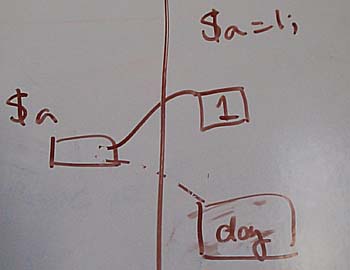 An object can also be released / marked for destruction by an action as simple as an assignment of a different value to the same name - in this example, [PHP], $a=1; might render a big old object no longer available to your code. An object can also be released / marked for destruction by an action as simple as an assignment of a different value to the same name - in this example, [PHP], $a=1; might render a big old object no longer available to your code.You'll notice that I've said that objects are MARKED FOR destruction, rather than actually being destroyed, when no longer accessible. The actual destruction is likely to be done some time later - in bulk when the application needs to get the memory back, or is about to exit (each remaining object's destructor is always run just before the program exits). Irritating though it is that the destructors don't run straight off, it's also a huge efficiency gain for them to be run in bulk / blocks. (written 2009-05-11, updated 2009-05-12) Associated topics are indexed as below, or enter http://melksh.am/nnnn for individual articles Q906 - Object Orientation and General technical topics - Object Orientation: Individual Objects[227] Bellringing and Programming and Objects and Perl - (2005-02-25) [507] Introduction to Object Oriented Programming - (2005-11-27) [1543] Learning Object Oriented Principles (and perhaps Java) - (2008-02-17) [1864] Object Oriented Perl - First Steps - (2008-11-01) [1925] Introduction to Object Oriented Programming - (2008-12-06) [2173] Basic OO principles - (2009-05-11) [2393] A first demonstration of OO, including polymorphism - (2009-09-04) [2651] Calculation within objects - early, last minute, or cached? - (2010-02-26) [3436] Moving from scripting to Object Orientation in Python - (2011-09-13) [3721] Naming blocks of code, structures and Object Orientation - efficient coding in manageable chunks - (2012-05-06) [4021] Spike solution, refactored and reusable, Python - Example - (2013-02-28) [4448] What is the difference between a function and a method? - (2015-03-04) [4591] From single block to structure and object oriented programming - (2015-12-02) [4650] Why populate object with values as you construct them? - (2016-02-18) H108 - Objects in PHP [67] Object Oriented Programming in PHP - (2004-09-29) [124] PHP v Java - (2004-11-20) [205] PHP5 lets you say no - (2005-02-07) [343] Should I use structured or object oriented? - (2005-06-10) [421] Don't repeat code - use loops or functions - (2005-08-21) [485] North, Norther and Northest - PHP 5 Objects - (2005-11-04) [656] Think about your design even if you don't use full UML - (2006-03-24) [720] Planning a hotel refurb - an example of a Gant chart in PHP - (2006-05-14) [836] Build on what you already have with OO - (2006-08-17) [1027] Cue the music, I'm happy. - (2007-01-09) [1153] Object Oriented Model - a summary of changes from PHP4 to PHP5 - (2007-04-18) [1217] What are factory and singleton classes? - (2007-06-04) [1535] OO PHP demonstration - comparing objects and more - (2008-02-08) [1682] Accounts in PHP - an OO demo - (2008-06-19) [1819] Calling base class constructors - (2008-10-03) [1820] Sorting objects in PHP - (2008-10-04) [2160] PHP - getclass v instanceof - (2009-05-07) [2169] When should I use OO techniques? - (2009-05-11) [2172] PHP4 v PHP5 - Object Model Difference - (2009-05-11) [2380] Object Oriented programming - a practical design example - (2009-08-27) [2434] Abstract classes, Interfaces, PHP and Java - (2009-10-03) [2435] Serialization - storing and reloading objects - (2009-10-04) [2632] Shipping a test harness with your class in PHP - (2010-02-12) [2641] Object Oriented Programming in PHP - (2010-02-19) [2680] Static class members in PHP - a documented example - (2010-03-16) [2717] The Multiple Inheritance Conundrum, interfaces and mixins - (2010-04-11) [2741] What is a factory? - (2010-04-26) [2774] PHP - Object Oriented Design in use - (2010-05-21) [2921] Does copying a variable duplicate the contents? - (2010-08-14) [2922] Getting the OO design write - with PHP a example - (2010-08-14) [3142] Private and Public - and things between - (2011-01-22) [3210] Catchable fatal error in PHP ... How to catch, and alternative solutions such as JSON - (2011-03-22) [3211] Computer Graphics in PHP - World (incoming data) to Pixel (screen) conversion - (2011-03-24) [3607] Designing your application - using UML techniques - (2012-02-11) [3608] Design Patterns - what are they? Why use them? - (2012-02-12) [3609] How do classes relate to each other? Associated Classes - (2012-02-12) [3840] Autoload in PHP - (2012-08-17) [3841] Copying, duplicating, cloning an object in PHP - (2012-08-18) [3843] Caching Design Patterns - (2012-08-20) [3953] Objects in PHP - Revision - (2012-12-16) [4057] stdClass in PHP - using an object rather than an associative array - (2013-04-02) [4073] Learning about Object Orientation in PHP - a new set of examples - (2013-04-28) [4356] Object factories in C++, Python, PHP and Perl - (2014-12-19) [4366] Changing what operators do on objects - a comparison across different programming languages - (2014-12-26) [4626] Singleton design pattern - examples and uses - (2016-01-20) [4627] Caching results in an object for efficiency - avoiding re-calculation - (2016-01-20) [4628] Associative objects - one object within another. - (2016-01-20)
Some other Articles
Melksham in picturesApplication design in PHP - multiple step processes Cleaning up redundant objects Designing a heirarcy of classes - getting inheritance right In honour of the photograph, I present ... a walk from Reybridge to Lacock Watching the tele Crossrefering documents with uniqueness and inconsistency issues - PHP proof of concept demo |
4759 posts, page by page
Link to page ... 1, 2, 3, 4, 5, 6, 7, 8, 9, 10, 11, 12, 13, 14, 15, 16, 17, 18, 19, 20, 21, 22, 23, 24, 25, 26, 27, 28, 29, 30, 31, 32, 33, 34, 35, 36, 37, 38, 39, 40, 41, 42, 43, 44, 45, 46, 47, 48, 49, 50, 51, 52, 53, 54, 55, 56, 57, 58, 59, 60, 61, 62, 63, 64, 65, 66, 67, 68, 69, 70, 71, 72, 73, 74, 75, 76, 77, 78, 79, 80, 81, 82, 83, 84, 85, 86, 87, 88, 89, 90, 91, 92, 93, 94, 95, 96 at 50 posts per pageThis is a page archived from The Horse's Mouth at http://www.wellho.net/horse/ - the diary and writings of Graham Ellis. Every attempt was made to provide current information at the time the page was written, but things do move forward in our business - new software releases, price changes, new techniques. Please check back via our main site for current courses, prices, versions, etc - any mention of a price in "The Horse's Mouth" cannot be taken as an offer to supply at that price.
Link to Ezine home page (for reading).
Link to Blogging home page (to add comments).
PH: 01144 1225 708225 • EMAIL: info@wellho.net • WEB: http://www.wellho.net • SKYPE: wellho
PAGE: http://www.wellho.net/mouth/2171_Cle ... jects.html • PAGE BUILT: Sun Oct 11 16:07:41 2020 • BUILD SYSTEM: JelliaJamb