
|
Training, Open Source Programming Languages |
| Home | Accessibility | Courses | The Mouth | Resources | Site Map | About Us | Contact |
| For 2023 (and 2024 ...) - we are now fully retired from IT training. We have made many, many friends over 25 years of teaching about Python, Tcl, Perl, PHP, Lua, Java, C and C++ - and MySQL, Linux and Solaris/SunOS too. Our training notes are now very much out of date, but due to upward compatability most of our examples remain operational and even relevant ad you are welcome to make us if them "as seen" and at your own risk. Lisa and I (Graham) now live in what was our training centre in Melksham - happy to meet with former delegates here - but do check ahead before coming round. We are far from inactive - rather, enjoying the times that we are retired but still healthy enough in mind and body to be active! I am also active in many other area and still look after a lot of web sites - you can find an index ((here)) |
|
Designing a heirarcy of classes - getting inheritance right
You friend Will has written a class to handle management information about articles. It's great as far as it goes, but you want to add extra stuff to it, so you persuade Will to give you a copy. He's a nice guy, he does so ... but then a month later he tells you he's added a lot more code and you're forced to make a lot of changes to your derivative work ... and so is Jane, to whom you had in turn passed a copy of the code. Far, far better to write the code to OO principles, in which you simply write a file that describes the changes and can be automatically applied when you get Will's update. But this requires careful class design. Here are some of the principles involved ...  From a class of "article", I have specified three derived classes - blog article, web published article and metro article. The blog article in turn is split into published and draft, and the draft is further split into withdrawn and future. In each case of inheritance, the class on which the new class is based is known as the "base class" and the newly created class is known as the "sub class" ... and we call this extending a class. This might sound back to front at first, but when you consider that you extend the code to create a class that will be more specific and have fewer members, it starts to make sense. From a class of "article", I have specified three derived classes - blog article, web published article and metro article. The blog article in turn is split into published and draft, and the draft is further split into withdrawn and future. In each case of inheritance, the class on which the new class is based is known as the "base class" and the newly created class is known as the "sub class" ... and we call this extending a class. This might sound back to front at first, but when you consider that you extend the code to create a class that will be more specific and have fewer members, it starts to make sense.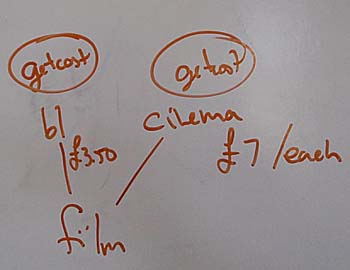 A base class of film contains a lot of methods and data .. but we have had to subclass it to "blockbuster" and "cinema" for our "getcost" method ... since you pay per person at the cinema, but per film hired from Blockbuster - a different algorithm demanding a different (but related) class A base class of film contains a lot of methods and data .. but we have had to subclass it to "blockbuster" and "cinema" for our "getcost" method ... since you pay per person at the cinema, but per film hired from Blockbuster - a different algorithm demanding a different (but related) class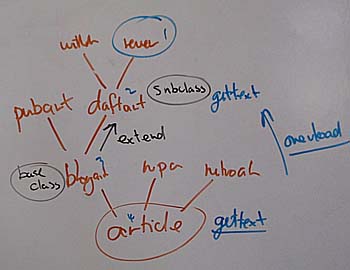 In order to minimise the amount of code you need, you should put common code as near to the root of the tree as possible. In this specification example, you'll see that I have put "gettext" into the base article class, as it's common over most of the subclasses. I have then added a separate "gettext" method into my draft brog article class, as that works on different principles. This replacement technique is overloading In order to minimise the amount of code you need, you should put common code as near to the root of the tree as possible. In this specification example, you'll see that I have put "gettext" into the base article class, as it's common over most of the subclasses. I have then added a separate "gettext" method into my draft brog article class, as that works on different principles. This replacement technique is overloading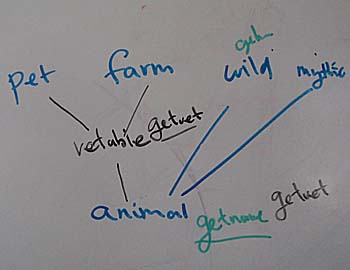 Where there's no obvious way to overload a class, the addition of an intermediate class in the hierarchy - even if it's an object typel you'll never create - can help you out. In this example, I wanted a "getvet" method that applied to classes farm and pet, and a different one that applied to classes mythical and wild. But I didn't want to write either piece of code twice. The solution was to use an intermediate ("abstract") class .. and have one of the pieces of code in the base class, and the other in the abstract class. Where there's no obvious way to overload a class, the addition of an intermediate class in the hierarchy - even if it's an object typel you'll never create - can help you out. In this example, I wanted a "getvet" method that applied to classes farm and pet, and a different one that applied to classes mythical and wild. But I didn't want to write either piece of code twice. The solution was to use an intermediate ("abstract") class .. and have one of the pieces of code in the base class, and the other in the abstract class.(written 2009-05-11, updated 2009-05-12) Associated topics are indexed as below, or enter http://melksh.am/nnnn for individual articles Q909 - Object Orientation and General technical topics - Object Orientation: Composite Objects[477] Class, static and unbound variables - (2005-10-25) [592] NOT Gone phishing - (2006-02-05) [1345] Perl and Shell coding standards / costs of an IT project - (2007-09-11) [1348] Screw it or Glue it? Access to Object variables - a warning - (2007-09-12) [2641] Object Oriented Programming in PHP - (2010-02-19) [2865] Relationships between Java classes - inheritance, packaging and others - (2010-07-10) [2922] Getting the OO design write - with PHP a example - (2010-08-14) [3142] Private and Public - and things between - (2011-01-22) [3152] Jargon busting - (2011-01-30) [3251] C++ - objects that are based on other objects, saving coding and adding robustness - (2011-04-17) [3609] How do classes relate to each other? Associated Classes - (2012-02-12) [3979] Extended and Associated objects - what is the difference - C++ example - (2013-01-18) [4377] Designing a base class and subclasses, and their extension, in C++ - (2015-01-01) [4394] Philosophy behind object design - and how I applied in to a Java example - (2015-01-14) [4450] Deciding whether to use parameters, conditional statements or subclasses - (2015-03-05) Q907 - Object Orientation and General technical topics - Object Orientation: Design Techniques [80] OO - real benefits - (2004-10-09) [236] Tapping in on resources - (2005-03-05) [507] Introduction to Object Oriented Programming - (2005-11-27) [534] Design - one name, one action - (2005-12-19) [656] Think about your design even if you don't use full UML - (2006-03-24) [747] The Fag Packet Design Methodology - (2006-06-06) [831] Comparison of Object Oriented Philosophy - Python, Java, C++, Perl - (2006-08-13) [836] Build on what you already have with OO - (2006-08-17) [1047] Maintainable code - some positive advice - (2007-01-21) [1217] What are factory and singleton classes? - (2007-06-04) [1224] Object Relation Mapping (ORM) - (2007-06-09) [1435] Object Oriented Programming in Perl - Course - (2007-11-18) [1528] Object Oriented Tcl - (2008-02-02) [1538] Teaching Object Oriented Java with Students and Ice Cream - (2008-02-12) [2169] When should I use OO techniques? - (2009-05-11) [2327] Planning! - (2009-08-08) [2380] Object Oriented programming - a practical design example - (2009-08-27) [2501] Simples - (2009-11-12) [2523] Plan your application before you start - (2009-12-02) [2717] The Multiple Inheritance Conundrum, interfaces and mixins - (2010-04-11) [2741] What is a factory? - (2010-04-26) [2747] Containment, Associative Objects, Inheritance, packages and modules - (2010-04-30) [2785] The Light bulb moment when people see how Object Orientation works in real use - (2010-05-28) [2878] Program for reliability and efficiency - do not duplicate, but rather share and re-use - (2010-07-19) [2889] Should Python classes each be in their own file? - (2010-07-27) [2953] Turning an exercise into the real thing with extreme programming - (2010-09-11) [2977] What is a factory method and why use one? - Example in Ruby - (2010-09-30) [3063] Comments in and on Perl - a case for extreme OO programming - (2010-11-21) [3085] Object Oriented Programming for Structured Programmers - conversion training - (2010-12-14) [3260] Ruby - a training example that puts many language elements together to demonstrate the whole - (2011-04-23) [3454] Your PHP website - how to factor and refactor to reduce growing pains - (2011-09-24) [3607] Designing your application - using UML techniques - (2012-02-11) [3760] Why you should use objects even for short data manipulation programs in Ruby - (2012-06-10) [3763] Spike solutions and refactoring - a Python example - (2012-06-13) [3798] When you should use Object Orientation even in a short program - Python example - (2012-07-06) [3844] Rooms ready for guests - each time, every time, thanks to good system design - (2012-08-20) [3878] From Structured to Object Oriented Programming. - (2012-10-02) [3887] Inheritance, Composition and Associated objects - when to use which - Python example - (2012-10-10) [3928] Storing your intermediate data - what format should you you choose? - (2012-11-20) [3978] Teaching OO - how to avoid lots of window switching early on - (2013-01-17) [4098] Using object orientation for non-physical objects - (2013-05-22) [4374] Test driven development, and class design, from first principles (using C++) - (2014-12-30) [4430] The spirit of Java - delegating to classes - (2015-02-18) [4449] Spike solution, refactoring into encapsulated object methods - good design practise - (2015-03-05) [4628] Associative objects - one object within another. - (2016-01-20)
Some other Articles
Application design in PHP - multiple step processesBasic OO principles PHP4 v PHP5 - Object Model Difference Cleaning up redundant objects Designing a heirarcy of classes - getting inheritance right In honour of the photograph, I present ... a walk from Reybridge to Lacock Watching the tele Crossrefering documents with uniqueness and inconsistency issues - PHP proof of concept demo Making Regular Expressions easy to read and maintain |
4759 posts, page by page
Link to page ... 1, 2, 3, 4, 5, 6, 7, 8, 9, 10, 11, 12, 13, 14, 15, 16, 17, 18, 19, 20, 21, 22, 23, 24, 25, 26, 27, 28, 29, 30, 31, 32, 33, 34, 35, 36, 37, 38, 39, 40, 41, 42, 43, 44, 45, 46, 47, 48, 49, 50, 51, 52, 53, 54, 55, 56, 57, 58, 59, 60, 61, 62, 63, 64, 65, 66, 67, 68, 69, 70, 71, 72, 73, 74, 75, 76, 77, 78, 79, 80, 81, 82, 83, 84, 85, 86, 87, 88, 89, 90, 91, 92, 93, 94, 95, 96 at 50 posts per pageThis is a page archived from The Horse's Mouth at http://www.wellho.net/horse/ - the diary and writings of Graham Ellis. Every attempt was made to provide current information at the time the page was written, but things do move forward in our business - new software releases, price changes, new techniques. Please check back via our main site for current courses, prices, versions, etc - any mention of a price in "The Horse's Mouth" cannot be taken as an offer to supply at that price.
Link to Ezine home page (for reading).
Link to Blogging home page (to add comments).
PH: 01144 1225 708225 • EMAIL: info@wellho.net • WEB: http://www.wellho.net • SKYPE: wellho
PAGE: http://www.wellho.net/mouth/2170_Des ... right.html • PAGE BUILT: Sun Oct 11 16:07:41 2020 • BUILD SYSTEM: JelliaJamb