
|
Training, Open Source Programming Languages |
| Home | Accessibility | Courses | The Mouth | Resources | Site Map | About Us | Contact |
| For 2023 (and 2024 ...) - we are now fully retired from IT training. We have made many, many friends over 25 years of teaching about Python, Tcl, Perl, PHP, Lua, Java, C and C++ - and MySQL, Linux and Solaris/SunOS too. Our training notes are now very much out of date, but due to upward compatability most of our examples remain operational and even relevant ad you are welcome to make us if them "as seen" and at your own risk. Lisa and I (Graham) now live in what was our training centre in Melksham - happy to meet with former delegates here - but do check ahead before coming round. We are far from inactive - rather, enjoying the times that we are retired but still healthy enough in mind and body to be active! I am also active in many other area and still look after a lot of web sites - you can find an index ((here)) |
|
Regular Expressions in PHP
Regular Expressions allow you to check if a string of text matches a particular pattern - for example to see if the data that a user has entered into a form looks like a Postcode / zipcode ... and then to extract the vital parts of the string that you're checking into separate variables. 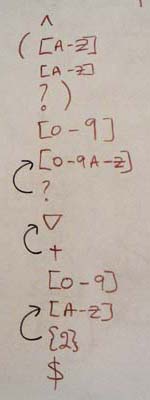 Down the left here, I've written the regular expression to match a British Postcode - this involves describing what a postcode looks like in great detail. Down the left here, I've written the regular expression to match a British Postcode - this involves describing what a postcode looks like in great detail.Here are some of the elements: ^ - Starts with [A-Z] - Capital Letter [0-9] - Digit + - one or more of the previous item ? - previous item is optional {2} - exactly 2 of the previous item $ - ends with The round brackets are known as "capture parentheses" - or in easy English, they're used to indicate which parts of the pattern match against interesting bits of the incoming string that you would like to capture into separate variables when you match. 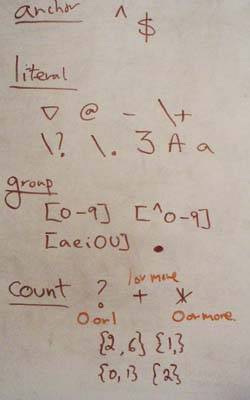 There are complete books on regular expressions, but this summary to the right shows you the basic types of elements ... There are complete books on regular expressions, but this summary to the right shows you the basic types of elements ...Anchors or "zero width assersions" indicate thinsg like "starts with" and "ends with" so you can match at the beginning, in the middle, at the end of, or a whole string. Literals match a single character (perhaps modified by a following count) exactly. Character groups match any one character from a whole group of possibilities (perhaps modified by a following count) exactly. Counts say how many times the previous element may occur - the default is once. You can also use (...) to group elements for capture, | which means "or" (a.k.a. alternation) and a few other types. There are two regular expression engines in PHP - there's the ereg series which are based on POSIX regular expressions, and the preg series which are based on the Perl standard. In easy terms, the preg flavour are shorter to write and more efficient in operation, but harder to understand and maintain. 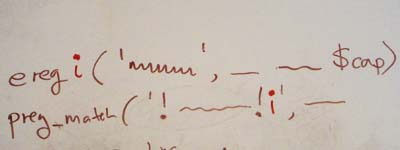 One of the big questions with Regular Expressions is "are they case sensitive?" By default, yes they are, but you can add an "i" to ignore case - in different places in the syntax depending on if you're using ereg or preg. One of the big questions with Regular Expressions is "are they case sensitive?" By default, yes they are, but you can add an "i" to ignore case - in different places in the syntax depending on if you're using ereg or preg.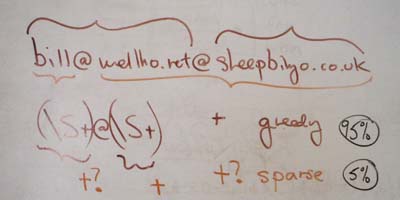 If you're matching and capturing, you need to be very careful just which parts of the regular expression engine match which parts of the incoming string, as there can be many alternatives. You should remember that matching always starts as far to the left as it can, and that counts such as "+" always match as MANY characters as possible. If you use counts such as "+?" instead, then you're doing what is called a "sparse" rather than a "greedy" match, and that will match as few characters as possible. If you're matching and capturing, you need to be very careful just which parts of the regular expression engine match which parts of the incoming string, as there can be many alternatives. You should remember that matching always starts as far to the left as it can, and that counts such as "+" always match as MANY characters as possible. If you use counts such as "+?" instead, then you're doing what is called a "sparse" rather than a "greedy" match, and that will match as few characters as possible. The diagram shows the effect of sparse v greedy on a match to an email address with two @ characters in it. Most of the time, it'll be greedy you want to use ... sparse is useful especially when you're identifying / stripping HTML tags, though. The boards / notes above come from the PHP Techniques Workshop that I was presenting yesterday ... it's a regular public course and we would welcome YOU on it ;-) (written 2008-09-16) Associated topics are indexed as below, or enter http://melksh.am/nnnn for individual articles Q802 - Object Orientation and General technical topics - Regular Expression Elements[453] Commenting Perl regular expressions - (2005-09-30) [1480] Next course - 7th January 2008, Regular Expressions - (2007-12-21) [1766] Diagrams to show you how - Tomcat, Java, PHP - (2008-08-22) [1849] String matching in Perl with Regular Expressions - (2008-10-20) [2804] Regular Expression Myths - (2010-06-13) [4505] Regular Expressions for the petrified - in Ruby - (2015-06-03) [4763] Regex Reference sheet - (2017-10-10) H107 - String Handling in PHP [31] Here documents - (2004-08-28) [54] PHP and natural sorting - (2004-09-19) [337] the array returned by preg_match_all - (2005-06-06) [422] PHP Magic Quotes - (2005-08-22) [463] Splitting the difference - (2005-10-13) [493] Running a Perl script within a PHP page - (2005-11-12) [558] Converting between acres and hectares - (2006-01-08) [560] The fencepost problem - (2006-01-10) [574] PHP - dividing a string up into pieces - (2006-01-23) [589] Robust PHP user inputs - (2006-02-03) [608] Don't expose your regular expressions - (2006-02-15) [642] How similar are two words - (2006-03-11) [716] Evaluating arithmetic expressions in configuration files - (2006-05-10) [728] Looking ahead and behind in a Regular Expression - (2006-05-22) [1008] Date conversion - PHP - (2006-12-26) [1058] PHP Regular expression to extrtact link and text - (2007-01-31) [1195] Regular Express Primer - (2007-05-20) [1336] Ignore case in Regular Expression - (2007-09-08) [1372] A taster PHP expression ... - (2007-09-30) [1533] Short and sweet and sticky - PHP form input - (2008-02-06) [1603] Do not SHOUT and do not whisper - (2008-04-06) [1613] Regular expression for 6 digits OR 25 digits - (2008-04-16) [2046] Finding variations on a surname - (2009-02-17) [2165] Making Regular Expressions easy to read and maintain - (2009-05-10) [2238] Handling nasty characters - Perl, PHP, Python, Tcl, Lua - (2009-06-14) [2629] Curly braces within double quoted strings in PHP - (2010-02-09) [3020] Handling (expanding) tabs in PHP - (2010-10-29) [3424] Divide 10000 by 17. Do you get 588.235294117647, 588.24 or 588? - Ruby and PHP - (2011-09-08) [3515] PHP - moving from ereg to preg for regular expressions - (2011-11-11) [3516] Regular Expression modifiers in PHP - summary table - (2011-11-12) [3534] Learning to program in PHP - Regular Expression and Associative Array examples - (2011-12-01) [3788] Getting more than a yes / no answer from a regular expression pattern match - (2012-06-30) [3789] More than just matching with a regular expression in PHP - (2012-06-30) [3790] Solution looking for a problem? Lookahead and Lookbehind - (2012-06-30) [4071] Setting up strings in PHP - (2013-04-27) [4072] Splitting the difference with PHP - (2013-04-27)
Some other Articles
FTP passive mode - a sometimes cure for upload hangsMotorcycles welcome at Well House Manor Will your backups work if you have to restore them? Spiders Web Regular Expressions in PHP What does an browser understand? What does an HTML document contain? I have been working hard but I do not expect you noticed libwww-perl and Indy Library in your server logs? What have iTime, honeytrapagency and domain listing center got in common? Refactoring - a PHP demo becomes a production page |
4759 posts, page by page
Link to page ... 1, 2, 3, 4, 5, 6, 7, 8, 9, 10, 11, 12, 13, 14, 15, 16, 17, 18, 19, 20, 21, 22, 23, 24, 25, 26, 27, 28, 29, 30, 31, 32, 33, 34, 35, 36, 37, 38, 39, 40, 41, 42, 43, 44, 45, 46, 47, 48, 49, 50, 51, 52, 53, 54, 55, 56, 57, 58, 59, 60, 61, 62, 63, 64, 65, 66, 67, 68, 69, 70, 71, 72, 73, 74, 75, 76, 77, 78, 79, 80, 81, 82, 83, 84, 85, 86, 87, 88, 89, 90, 91, 92, 93, 94, 95, 96 at 50 posts per pageThis is a page archived from The Horse's Mouth at http://www.wellho.net/horse/ - the diary and writings of Graham Ellis. Every attempt was made to provide current information at the time the page was written, but things do move forward in our business - new software releases, price changes, new techniques. Please check back via our main site for current courses, prices, versions, etc - any mention of a price in "The Horse's Mouth" cannot be taken as an offer to supply at that price.
Link to Ezine home page (for reading).
Link to Blogging home page (to add comments).
PH: 01144 1225 708225 • EMAIL: info@wellho.net • WEB: http://www.wellho.net • SKYPE: wellho
PAGE: http://www.wellho.net/mouth/1799_Reg ... n-PHP.html • PAGE BUILT: Sun Oct 11 16:07:41 2020 • BUILD SYSTEM: JelliaJamb