
|
Training, Open Source Programming Languages |
| Home | Accessibility | Courses | The Mouth | Resources | Site Map | About Us | Contact |
| For 2023 (and 2024 ...) - we are now fully retired from IT training. We have made many, many friends over 25 years of teaching about Python, Tcl, Perl, PHP, Lua, Java, C and C++ - and MySQL, Linux and Solaris/SunOS too. Our training notes are now very much out of date, but due to upward compatability most of our examples remain operational and even relevant ad you are welcome to make us if them "as seen" and at your own risk. Lisa and I (Graham) now live in what was our training centre in Melksham - happy to meet with former delegates here - but do check ahead before coming round. We are far from inactive - rather, enjoying the times that we are retired but still healthy enough in mind and body to be active! I am also active in many other area and still look after a lot of web sites - you can find an index ((here)) |
|
Python GTK - Widget, Packing, Event and Feedback example
Python has a variety of GUIs available ... one of which, GTK, has been getting much more popular of late. As is common with many of the GUIs in Pyton and other languages, you'll typically write an application as follows:
Within the GUI, each widget must be defined, packed into the appropriate piece of Geometry, and shown (and the box and window containers also need to be shown) and - there you are - a simple GUI. As you use the GUI, you'll want to provide your user with feedback by altering the text on labels, buttons, and making other widget changes. Slightly surprisingly, you define all the possible actions early on then have your events trigger them as callback functions The authors of GUI documentation always seem to start with a very very simple "hello world" example, then leap off into some quite extravagant further example, when all you (the programmer) want is a few buttons to perform tasks (and change to show what you've done). Of course, I do know why they make them complicated as they've got dozens of events, scores of widgets and hundreds of facilities they would love you to use. But I'm going to break from convention today and point you in the direction of a simple Python Gtk example that starts like this:  showing the basic elements of a window, a box, and a couple of widgets. Events are defined on the first two buttons that change the text and the quit button is (!!) programmed to quit the GUI. showing the basic elements of a window, a box, and a couple of widgets. Events are defined on the first two buttons that change the text and the quit button is (!!) programmed to quit the GUI. As you run the GUI, you'll see the display counting up the number of times each button is pressed: 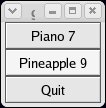 - thus completing that vital feedback element that you'll need in every GUI but never seems to be described in the manual until a footnote in chapter 5 or 6. - thus completing that vital feedback element that you'll need in every GUI but never seems to be described in the manual until a footnote in chapter 5 or 6. Complete (commented!) source code is here where you'll find further examples as well. (written 2007-04-09, updated 2011-10-13) Associated topics are indexed as below, or enter http://melksh.am/nnnn for individual articles Y212 - Python - Code testing, patterns, profiles and optimisation.[235] Preparation for a day's work - (2005-03-04) [1146] __new__ v __init__ - python constructor alternatives? - (2007-04-14) [1148] Python decorators - wrapping a method call in extra code - (2007-04-15) [1555] Advanced Python, Perl, PHP and Tcl training courses / classes - (2008-02-25) [2123] Using Python with OpenOffice - (2009-04-09) [2616] Defining a static method - Java, Python and Ruby - (2010-02-01) [3441] Pressing ^C in a Python program. Also Progress Bar. - (2011-09-15) [3442] A demonstration of how many Python facilities work together - (2011-09-16) [3464] Passing optional and named parameters to python methods - (2011-10-04) [3478] Testing your Python classes with the unittest package - how to - (2011-10-14) [3658] Using Make for a distribution - (2012-03-17) [4090] Test Driven Development in Python - Customer Comes First - (2013-05-16) [4326] Learning to program - comments, documentation and test code - (2014-11-22) [4344] Python base and inherited classes, test harness and unit testing - new examples - (2014-12-07) [4446] Combining tests into suites, and suites into bigger suites - Python and unittest - (2015-03-01) [4470] Testing in Python 3 - unittest, doctest and __name__ == __main__ too. - (2015-04-21) [4538] Flask and unittest - hello web app test world - (2015-10-15) [4540] Unittest of a Flask application including forms - (2015-10-15) [4542] The principle of mocking - and the Python Mock package - (2015-10-17) [4617] Pytest - starting example - (2016-01-07) [4618] Pytest - second example beyond hello world - (2016-01-08) [4716] Profiling your Python program - (2016-11-01) Y209 - Python GTK.
Some other Articles
Python dictionary for quick look upsA course in Helsinki Planters in the Spring A strong team broadens the professional coverage Python GTK - Widget, Packing, Event and Feedback example Overcrowded trains around Bristol The Holiday - unlikely romantic comedy? Wiltshire Circles Buffering output - why it is done and issues raised in Tcl, Perl, Python and PHP Government pressure on me to shut up after I make the papers |
4759 posts, page by page
Link to page ... 1, 2, 3, 4, 5, 6, 7, 8, 9, 10, 11, 12, 13, 14, 15, 16, 17, 18, 19, 20, 21, 22, 23, 24, 25, 26, 27, 28, 29, 30, 31, 32, 33, 34, 35, 36, 37, 38, 39, 40, 41, 42, 43, 44, 45, 46, 47, 48, 49, 50, 51, 52, 53, 54, 55, 56, 57, 58, 59, 60, 61, 62, 63, 64, 65, 66, 67, 68, 69, 70, 71, 72, 73, 74, 75, 76, 77, 78, 79, 80, 81, 82, 83, 84, 85, 86, 87, 88, 89, 90, 91, 92, 93, 94, 95, 96 at 50 posts per pageThis is a page archived from The Horse's Mouth at http://www.wellho.net/horse/ - the diary and writings of Graham Ellis. Every attempt was made to provide current information at the time the page was written, but things do move forward in our business - new software releases, price changes, new techniques. Please check back via our main site for current courses, prices, versions, etc - any mention of a price in "The Horse's Mouth" cannot be taken as an offer to supply at that price.
Link to Ezine home page (for reading).
Link to Blogging home page (to add comments).
PH: 01144 1225 708225 • EMAIL: info@wellho.net • WEB: http://www.wellho.net • SKYPE: wellho
PAGE: http://www.wellho.net/mouth/1140_Pyt ... ample.html • PAGE BUILT: Sun Oct 11 16:07:41 2020 • BUILD SYSTEM: JelliaJamb